
Difficulty Saying No Is Not a Character Flaw
You know you should say no.
But in the moment, something blocks you.
- You agree.
- You adapt.
- You push through.
Later, you may feel:
- fatigue
- irritation
- sometimes resentment
- often guilt
You have the impression that you are doing too much.
Yet refusing still feels even more difficult.
The Mechanism
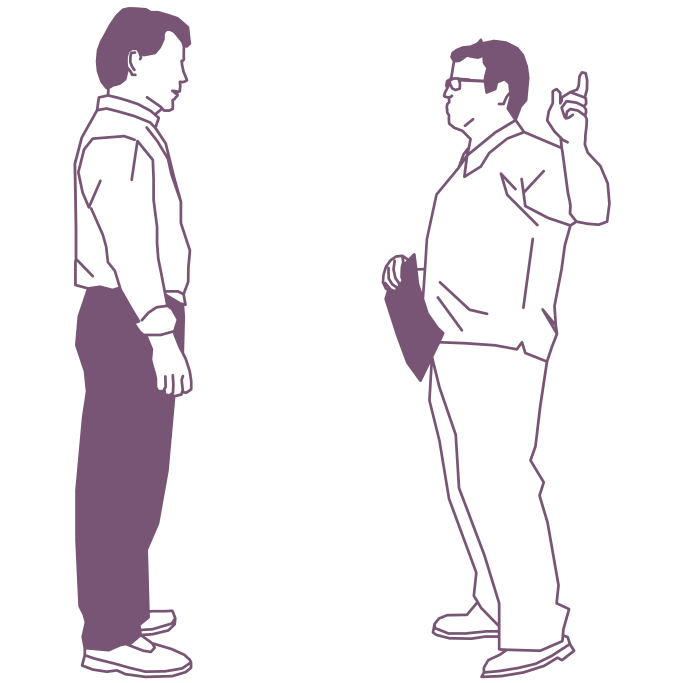
A request appears.
Someone needs something from you.
A thought arises:
- I can’t refuse.
- That would be selfish.
- They’ll take it badly.
- It’s not such a big deal.
The body tenses.
A sense of discomfort rises.
You say yes to make the tension disappear.
In the short term, the relief is immediate.
In the long term, the overload increases.
The guilt does not disappear.
It simply changes direction.
Where Does This Difficulty Come From?
Depending on your experiences, it may be linked to:
- a schema of approval-seeking
- a fear of conflict or rejection
- a tendency to erase yourself in order to preserve relationships
- taking on responsibility very early in life
From an IFS perspective, there is often a part that is highly attentive to others.
A part that monitors reactions, anticipates disappointment, and tries to maintain harmony.
It believes it is protecting the relationship.
But in doing so, it often pushes you into the background.
Understanding this dynamic helps resolve the inner conflict between “protecting myself” and “being a good person.”
What We Work On
The therapeutic work combines several approaches:
- CBT: identifying thoughts related to guilt and testing alternative responses
- Body regulation: learning to tolerate the discomfort that arises when setting a boundary
- Mindfulness: observing the rise of guilt without immediately acting to eliminate it
- IFS (Internal Family Systems): recognizing the part that tries to protect the relationship at all costs, understanding what it fears, and helping it adopt a more balanced role
- Schema therapy: working on deeper beliefs related to self-worth and the right to have needs
- Creative approaches, when relevant, to clarify internal conflicts between duty and desire
The aim is to develop the ability to set clear boundaries without disconnecting from yourself or from others.
What You Can Expect
Often, the first sessions already bring clarity:
you begin to understand that guilt has a function.
Over time, you may be able to:
- distinguish responsibility from over-responsibility
- express disagreement without inner collapse
- set more stable boundaries
- feel more legitimate in your own needs
The goal is to build more balanced relationships, where your place is recognized as much as that of others.